
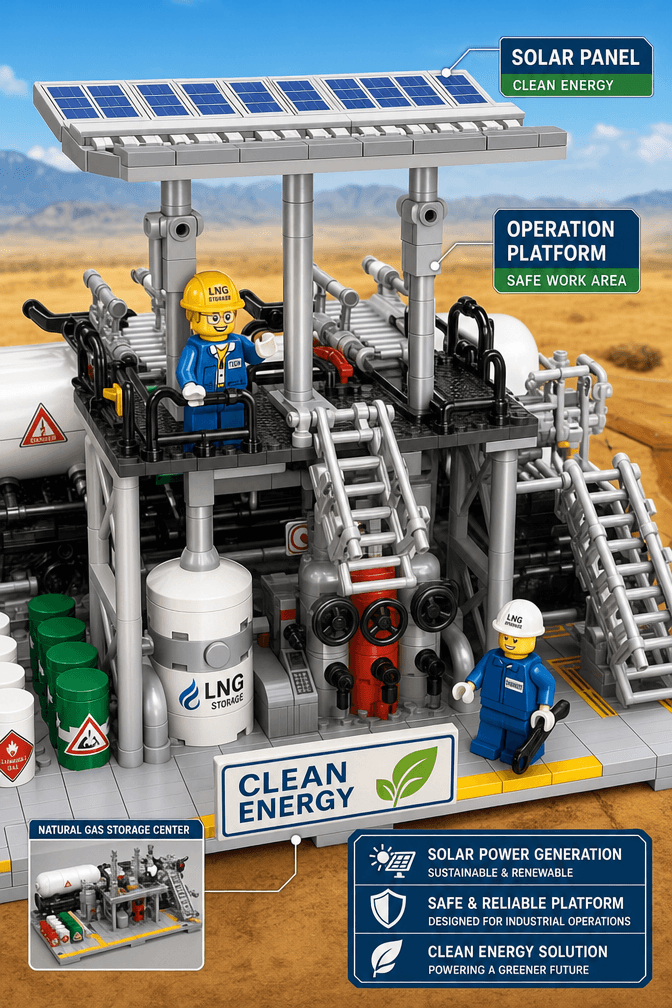
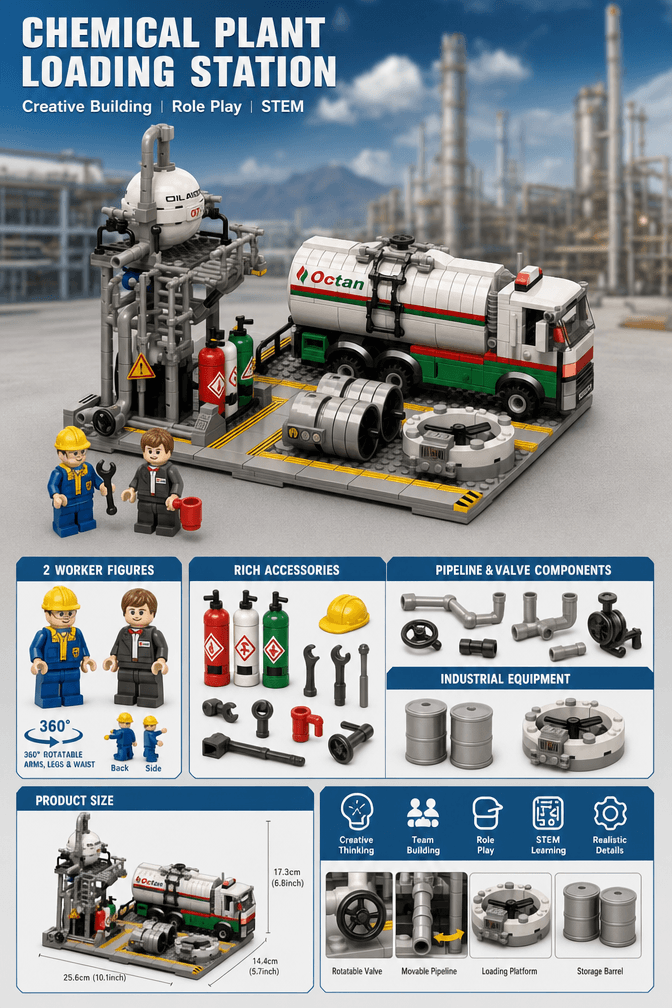
The Natural Gas Storage Center and Chemical Loading Station are close in piece count but different in scene focus. The 713-piece storage center emphasizes an LNG-style tank, stairs, pipework, solar canopy, and worker details. The 719-piece loading station adds a tanker truck and a stronger transport-and-transfer story.
This comparison uses the current Natural Gas Storage Center and Chemical Loading Station listings. It focuses on layout roles rather than temporary prices.
Choose the Natural Gas Storage Center for a tank-focused energy facility and stronger vertical infrastructure. Choose the Chemical Loading Station when a tanker truck and vehicle-based storytelling matter more.
Natural Gas Storage and Chemical Loading Compared
| Factor | Natural Gas Storage Center | Chemical Loading Station |
|---|---|---|
| Pieces | 713 | 719 |
| Finished size | About 27 × 21.9 × 19.6 cm | About 10.43 × 7.72 × 7.60 in |
| Current age guidance | Ages 6+ | Ages 8+ |
| Main landmark | LNG-style storage tank | Elevated tank and loading platform |
| Vehicle | No featured tanker truck in listed details | Tanker truck included |
| Best layout role | Storage and energy-infrastructure zone | Transfer, freight, and vehicle zone |
Which Has the Stronger Storage-Facility Silhouette?
The LNG-style tank creates a clearer storage identity
The storage center combines the tank with black pipework, stair platforms, raised work areas, a solar canopy, workers, and safety barrels. Those layers make it read as a compact energy facility even without a vehicle in front.
The Chemical Loading Station still contains an elevated storage tank, but its truck and platform shift attention toward transfer activity.
Which Creates More Vehicle-Based Storytelling?
The included tanker truck adds an arrival and departure story
The tanker can be placed approaching, aligned with the platform, or leaving the scene. Worker figures and safety signs help connect the vehicle to the fixed structure.
The Natural Gas Storage Center is better suited to a still facility scene. Vehicles can be added separately, but they are not the defining element of the current listed model.
Which Better Fits a Dense Factory District?
Use the storage center inside the district and the loading station near a road
The storage center can sit among refineries, pipes, and service buildings because its main story remains within the base. The loading station benefits from an open side where the tanker appears to enter and leave.
For a corner layout, place the storage center deeper in the scene and the loading station toward the front road. This allows both models to remain visible without competing for the same role.
Which Build Better Matches Different Collectors?
Choose Natural Gas Storage if...
- You want an LNG-style tank as the main landmark.
- Stairs, pipework, canopy, and raised platforms appeal to you.
- Your layout needs an energy-storage zone.
- Ages 6+ guidance better fits the intended builder.
Choose Chemical Loading if...
- You want a tanker truck included in the scene.
- Vehicle movement and worker storytelling matter.
- Your layout needs a loading or transfer edge.
- The current ages 8+ guidance fits the builder.
What If You Want Both?
Use the Natural Gas Storage Center as the storage block and the Chemical Loading Station as the transport block. Separate them with a road or service strip, then repeat barriers, warning colors, or lamps to connect the visual language.
An Oil Refinery can become the taller processing anchor behind them. Keep enough space around every model to lift it from the base without pulling on stairs, pipes, or tanker details.
Final Decision
The Natural Gas Storage Center wins when the layout needs a compact storage-facility landmark. The Chemical Loading Station wins when a vehicle and transfer story are the priority. Their similar piece counts make theme, age guidance, dimensions, and layout role more useful decision factors than size alone.
Compare the Current Industrial Sets
Review both live listings for current images, package contents, availability, and ordering details.
Product details were checked on October 2, 2026. This is a research-only comparison and does not use temporary prices.