
-1254x.jpg?w=1254&h=1254)
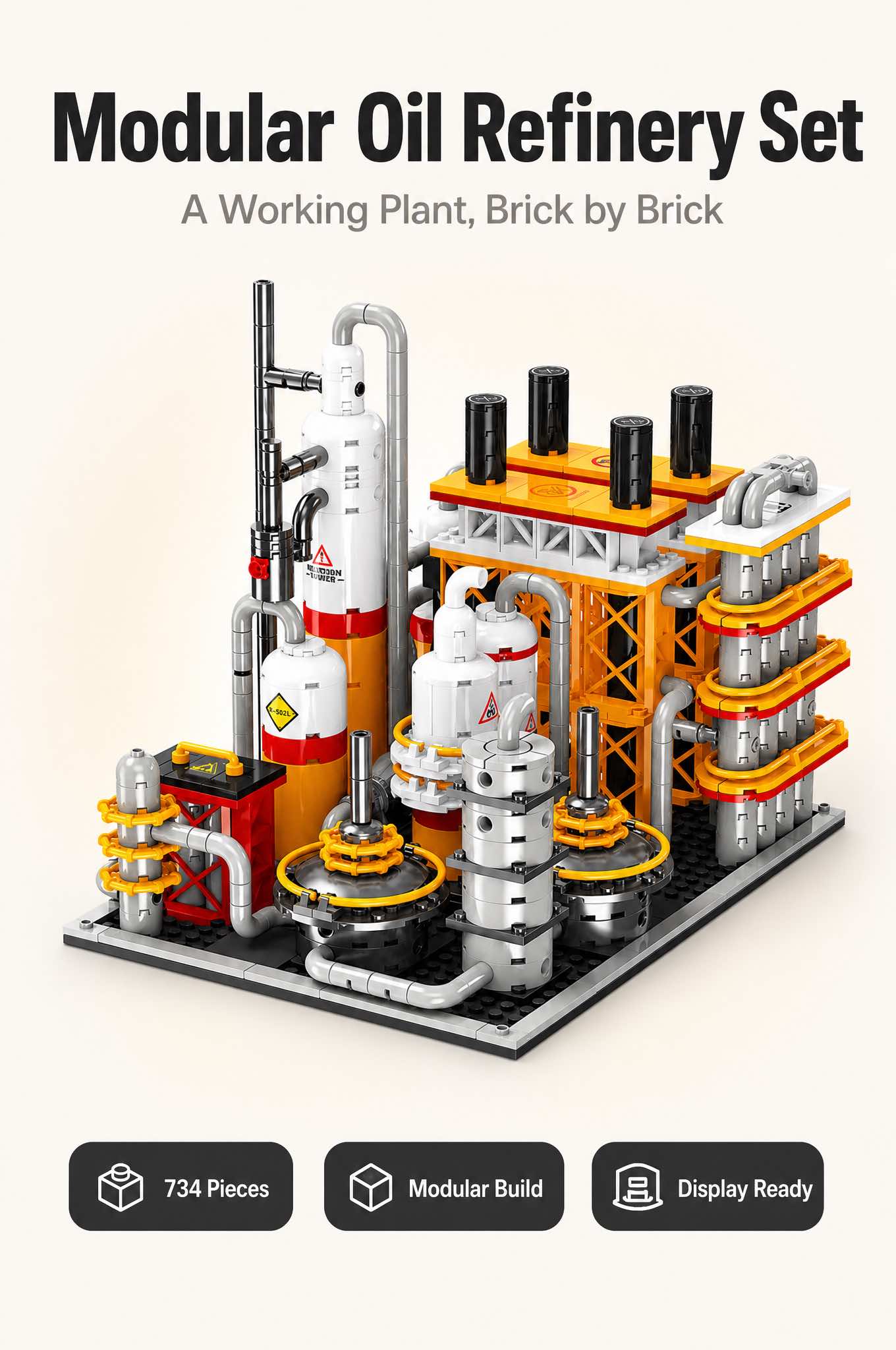
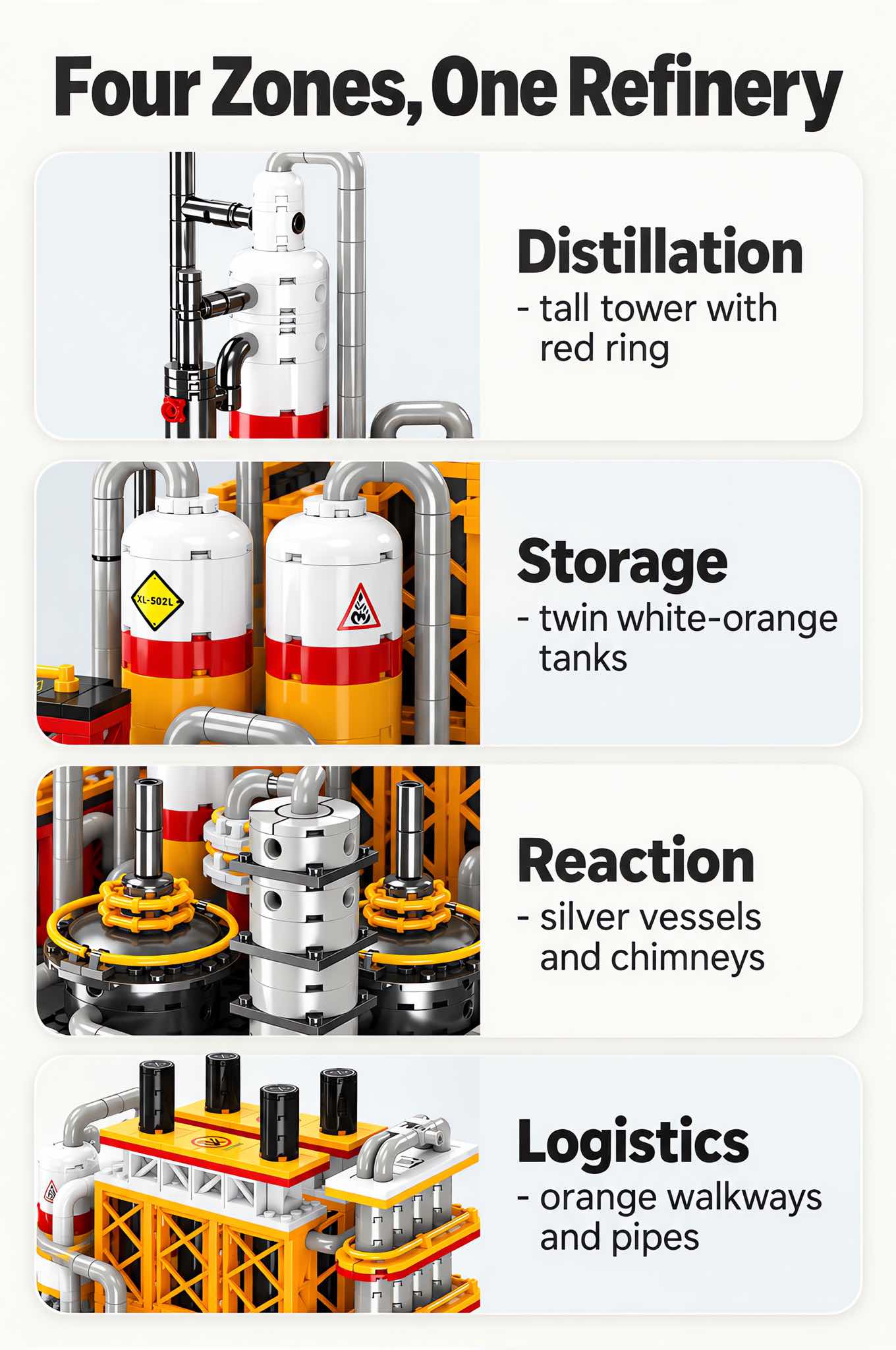
A refinery model becomes easier to understand when you read it as a collection of zones rather than one dense object. This 734-piece modular build uses towers, storage tanks, reactor-style vessels, elevated platforms, and interconnected pipework to create a compact industrial display.
The guide below shows how to plan the build, organize the visual hierarchy, and connect the model to a larger district. Details come from the current Modular Oil Refinery Building Block Set listing. The article is a research-based planning guide, not a hands-on product test.
Start With the Refinery's Visual Logic
Real petroleum refineries convert crude oil into petroleum products through many linked processes. The U.S. Energy Information Administration summarizes three basic stages as separation, conversion, and treatment, with crude oil and finished products stored temporarily in tanks near the refinery.
The brick model does not reproduce those processes at engineering scale. Instead, it uses familiar visual cues: tall processing towers, vessels, tanks, platforms, and pipes. Think of it as an architectural abstraction that helps a display communicate "refinery" at a glance.
Primary landmarks
Use the tallest towers as the main visual anchors. They should remain easy to see from the front and at a three-quarter viewing angle.
Secondary masses
Storage tanks and reactor-style vessels give the base weight. Their rounded shapes contrast with the towers and platforms.
Connecting lines
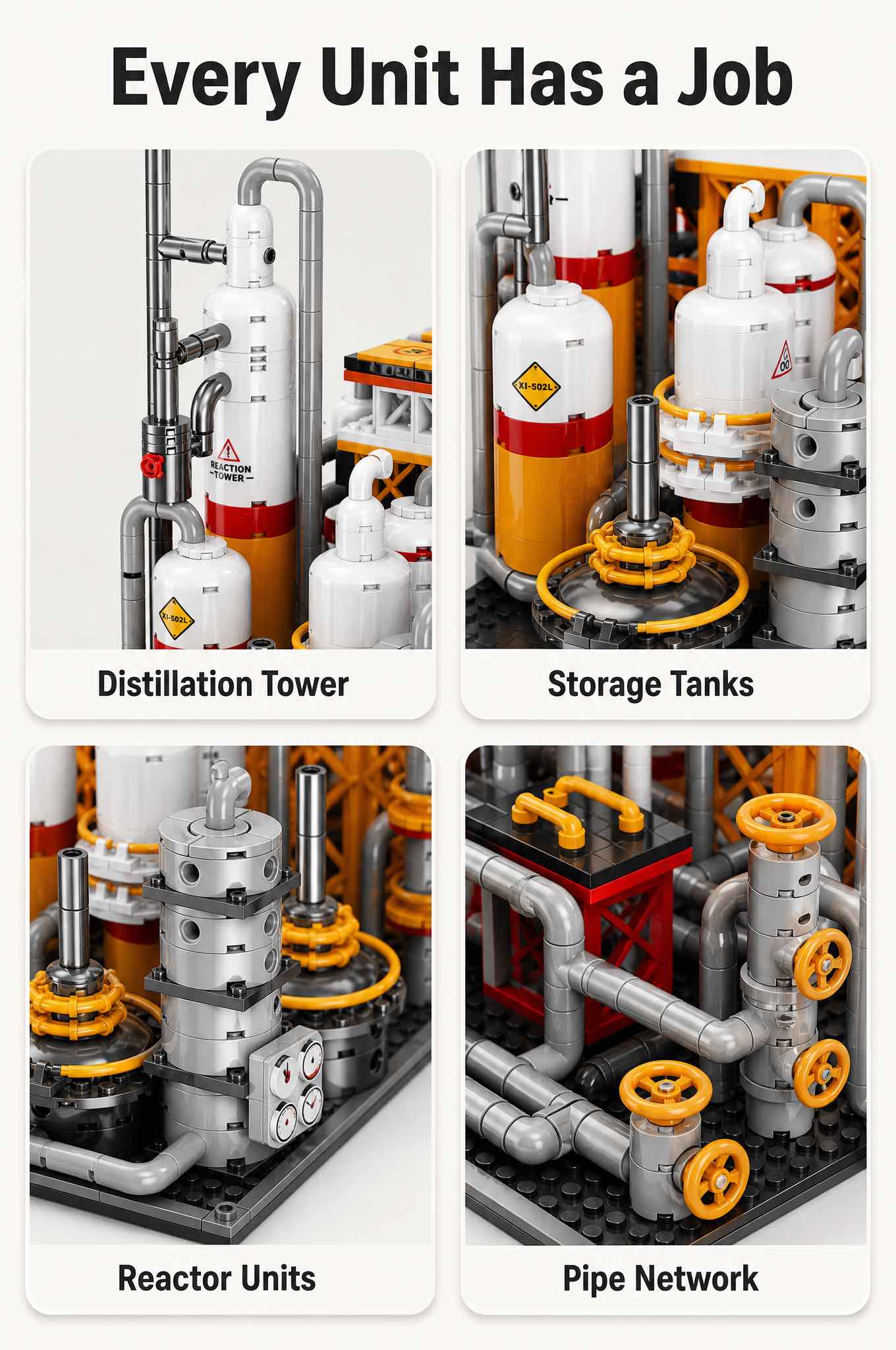
Pipework guides the eye between sections. Keep connections aligned as shown in the printed instructions before pressing them firmly into place.
Human scale
Platforms, stairs, and railings help viewers read the facility's size even though the model is decorative and simplified.
Use a Five-Stage Build Plan
- Prepare the footprint. Reserve a work area larger than the finished 25.6 × 20 × 21.8 cm model and sort long structural pieces separately.
- Complete the base modules. Follow the printed manual and verify each footprint before adding vertical structures.
- Build the tallest landmarks. Keep the towers upright and compare their attachment points before continuing.
- Add platforms and pipework. These smaller elements visually tie the modules together and are easier to place after the main masses are stable.
- Inspect from multiple angles. Check for loose railings, misaligned pipes, and pieces that may have shifted while handling the model.
Plan the Display Footprint Before Assembly
| Planning detail | Current listing | Display implication |
|---|---|---|
| Piece count | 734 pieces | Use several shallow sorting trays |
| Finished size | 25.6 × 20 × 21.8 cm | Allow clearance around towers and pipework |
| Material | ABS building bricks | Display on a firm, level surface |
| Instructions | Printed manual | Keep a clean reading area beside the build |
| Age guidance | 6+ | Adult guidance can help younger builders |
A shelf depth slightly greater than 20 cm gives the footprint room without forcing pipework against a wall. A three-quarter orientation usually reveals more connections than a straight-on view. If the shelf is high, place the tallest towers toward the back so they remain visible.
Use Lighting to Separate Dense Details
Industrial models can look visually flat when every pipe and vessel receives the same light. Place one diffuse light above and slightly to the side. That creates gentle shadow lines under platforms and around curved tanks. A neutral background keeps the yellow, red, gray, and metallic-looking elements from competing with a busy room.
For phone photography, use the three-quarter angle first, then take a lower detail shot of the pipe network. Avoid very wide lenses at close range because they can exaggerate the towers and make the base appear distorted.
Expand the Model Into a Connected District
The refinery can serve as the central processing chapter in a three-part industrial display. Position the Oil Pump Jack on one side to suggest extraction and the Oil & Gas Storage Station on the other to suggest storage and dispatch. Leave narrow visual corridors between the models rather than crowding every base together.
The listing also offers a complete 2,143-piece three-model option. Whether you start with one model or build the full sequence, the Engineering & Sci-Fi collection is the most direct place to compare compatible industrial themes.
Is This Refinery Model the Right Fit?
Choose it when you want a compact but visually layered architecture build with a printed manual and multiple industrial structures. The listing states that it is compatible with most major city-style brick systems, although fit can vary between manufacturers. It is a static decorative model, not real refinery equipment, and it is independently produced without endorsement by LEGO.
Build the Processing Center
Check current product images, availability, and ordering information before planning your display.
Product details were checked against the Wonder Mini World listing on September 26, 2026. Specifications and availability may change. This static decorative model is not real industrial equipment.